Memory-as-a-Service
Memory-as-a-Service (MaaS) turns the gateway into a memory provider. Applications get personalization and long-term context without operating their own vector store or graph database — just pass a memory_id on the request.
How it works
A memory session is a named, engine-backed store of facts tied to one organisation. On each request that references a session, the gateway runs two steps:
Pre-call (retrieval). The gateway takes the latest user message, searches the session for the top 3 relevant facts, and appends them to the system message:
[Past Context for ID: user-alice]
- Prefers summaries under 200 words
- Working on Q3 APAC analysis
- Last session: discussed Bedrock pricing
Post-call (storage). After the model responds, the gateway asynchronously stores the (user, assistant) turn in the session. Pass store_memory: false to skip storage on a single request.
The memory hook runs after guardrails, prompt injection, and compression — knowledge retrieval and web search follow it:
GuardrailHook → PromptHook → TokenSavingPlanHook → MemoryHook → KnowledgeHook → WebSearchHook
The memory_id is opaque to the upstream provider — it is stripped before the request is forwarded.
Activation
response = client.chat.completions.create(
    model="openai/gpt-5.5",
    messages=[{"role": "user", "content": "Remind me where we left off."}],
    extra_body={
        "memory_id": "user-alice",
        # "store_memory": False,   # omit (default true) to store this turn
    },
)
Pass memory_id top-level or inside metadata. A session can also be bound through a policy so it activates automatically.
Memory engines
Choose the engine when creating the session; it cannot be changed afterwards.
| Engine | Backend | Best for |
|---|---|---|
| Mem0 | Postgres + pgvector | User preferences, recent facts, short-to-medium semantic recall |
| Cognee | Postgres + pgvector + Neo4j | Entity and relationship knowledge, long-horizon reasoning |
Mem0 distinguishes keyword lookups from natural-language questions and deduplicates facts to avoid redundant storage. Vector search defaults to a 0.5 similarity threshold.
Cognee builds a knowledge graph from stored turns (remember) and answers retrieval with Cognee’s chunk (vector) search scoped to the session, supplemented by lexical matching and fact dedup. It deliberately does not use graph-completion search (which synthesises new answers rather than returning stored facts).
Creating a memory session
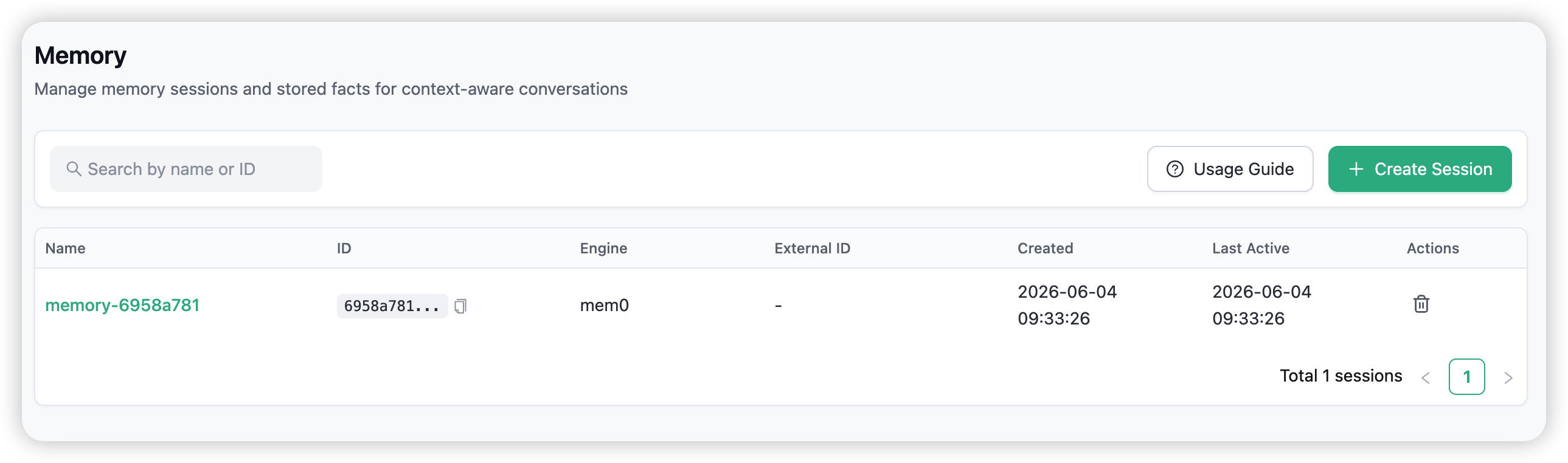
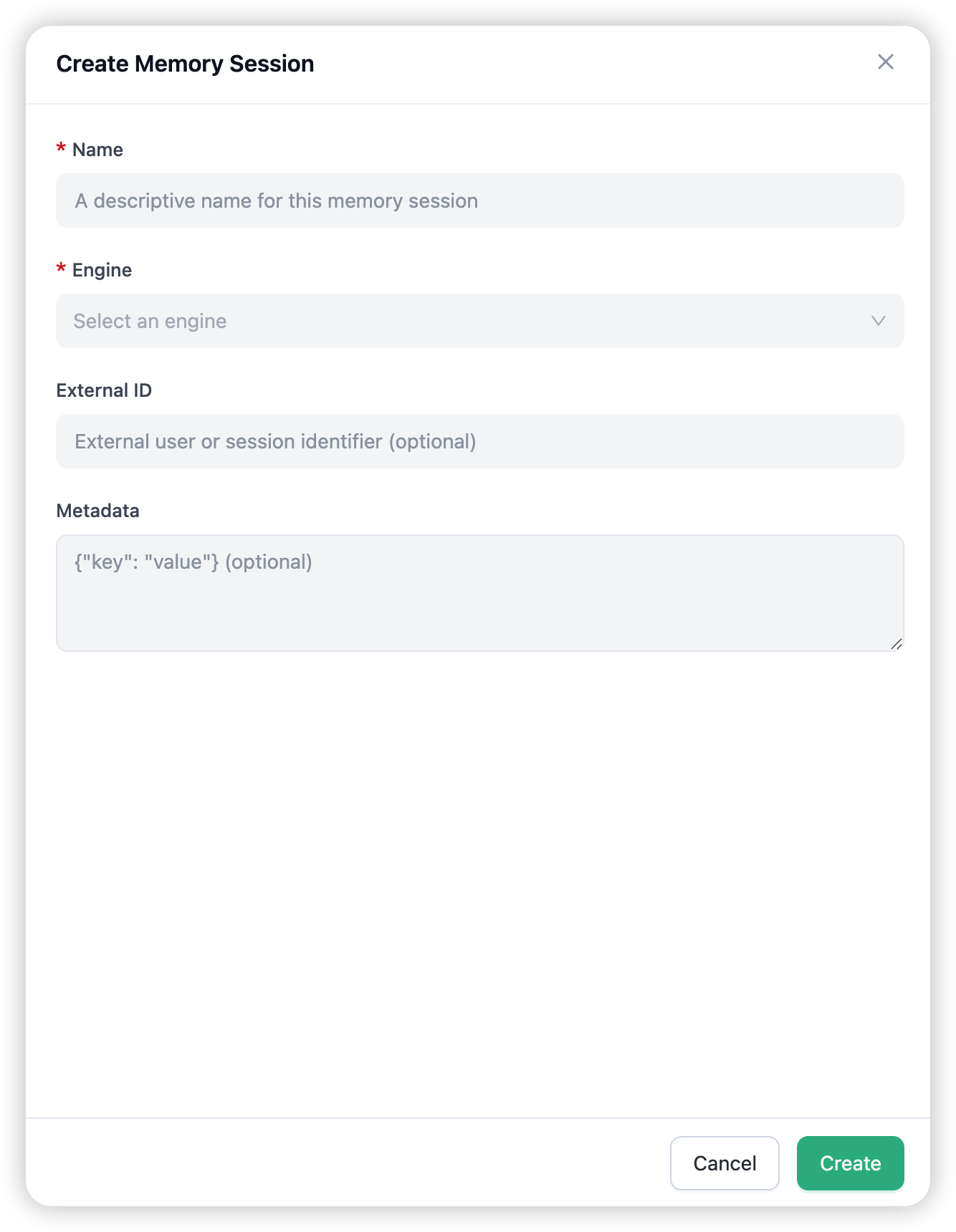
Open Memory and choose Create Session. The form takes a Name, an Engine (Mem0 or Cognee), an optional External ID, and optional Metadata. The returned memory_id (a UUID) is what callers pass on requests.
Managing stored facts
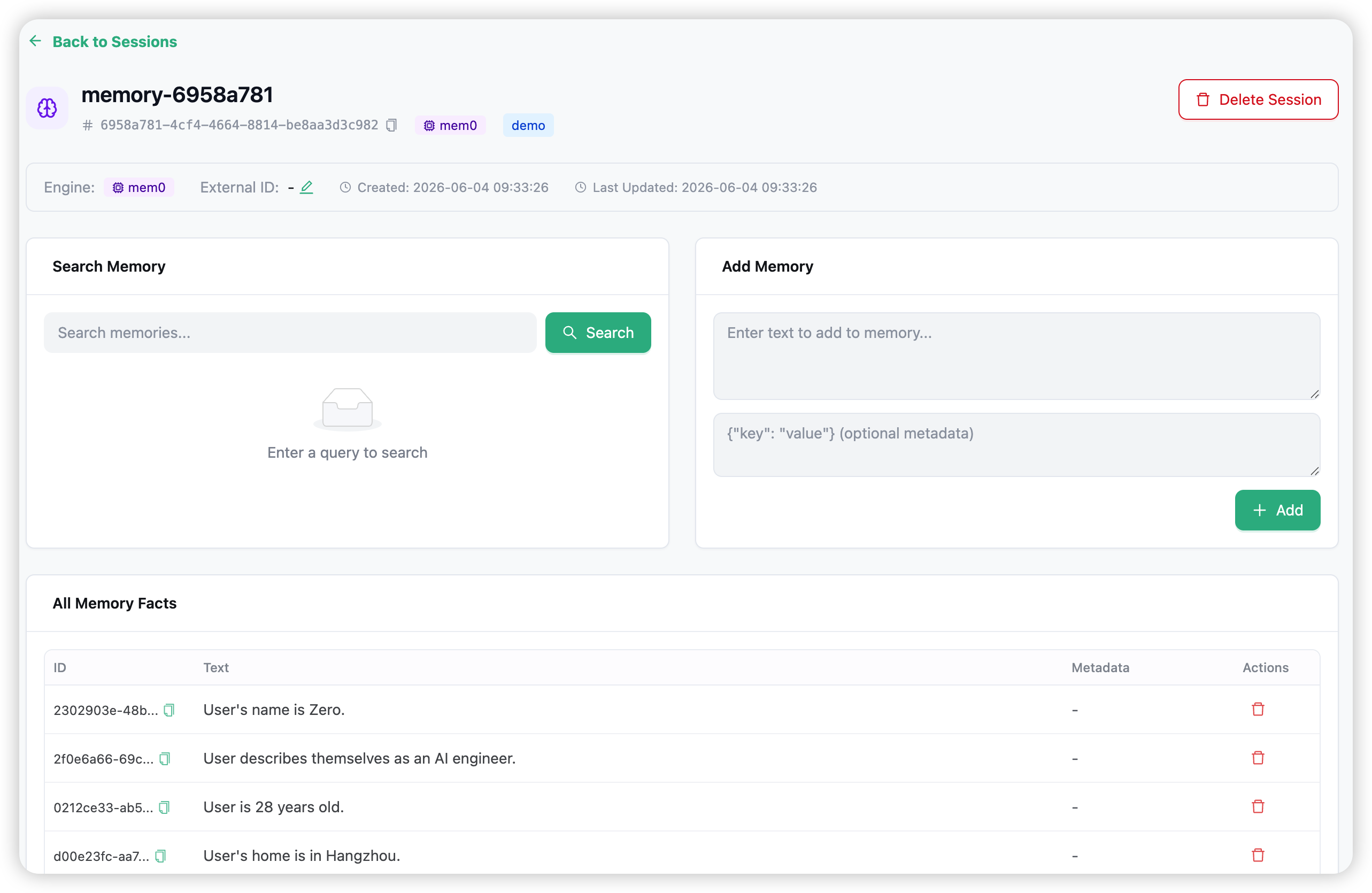
Each session’s detail page is where you work with the facts the memory holds:
- Search Memory — run a natural-language query against the session and see scored matches.
- Add Memory — ingest a fact directly, without going through a chat turn.
- All Memory Facts — browse and delete every stored fact in the session.
Organisation isolation and permissions
- Org-scoped. Sessions belong to one organisation. The table
LiteLLM_MemorySessionstores anorganization_idand enforces a unique(organization_id, name). - IDOR-protected. Operations are authorised per-org via Cerbos (
org:memory:common); the gateway also checks the session’s org at resolve time and rejects mismatches. - Who can manage. Proxy admins and organisation admins can create, edit, and delete sessions.
Internal cost accounting
The embedding and extraction calls the memory subsystem makes for storage and retrieval route back through the gateway under an internal service-account key (model internal-gpt-4o-mini with embedder internal-text-embedding-3-small; China region uses internal-qwen-plus with internal-text-embedding-v4). These costs are tracked as platform spend — never charged to the calling key.
Dependencies
| Engine | Required packages | Required infrastructure |
|---|---|---|
| Mem0 | mem0ai |
Postgres + pgvector |
| Cognee | cognee |
Postgres + pgvector + Neo4j |
Both are available in private deployments.
Combining with the rest of the gateway
- Policies — bind a session into a policy to activate it automatically on a key or model.
- Prompts / guardrails / token saving — the other AI Capabilities apply to the same request in their normal order.
- Playground — pick a memory session to enable automatic context injection and storage during a chat.
→ Policies for binding sessions to keys and models.